Bocharov Automated system-cognitive analysis of the impact of pre-university addi-tional mathematical education on the success of study at the university
Keywords:
Automated analysis, pre-university preparation, academic success, mathematical education, USE, Small Faculty of Mathematics, cognitive pedagogyAbstract
The article presents an analysis of the impact of pre-university supplementary mathematical education on academic success in higher education, conducted using Automated System-Cognitive Analysis (ASC-analysis) and its software tool, the "Eidos" intelligent system. The study covers a sample of 129 students from the Faculty of Mathematics and Computer Science at Kuban State University and aims to identify relationships between students' academic achievements and their preparation at the "Junior Faculty of Mathematics" (Junior Math Faculty) during their secondary school education, as well as their Unified State Exam (USE) results. The research addresses the tasks of cognitive structuring and formalization of the subject area, synthesis and verification of models, identification and forecasting, as well as the investigation of the modeled subject area through the study of its model. The results confirm the significance of pre-university preparation within the Junior Math Faculty and provide a well-founded conclusion regarding the strong positive correlation between preparation in this department and academic success at the university. This article briefly outlines the results of a previously conducted large-scale study [1-3].
References
Системно-когнитивный анализ влияния довузовского дополнительного математического образования на успешность обучения в вузе / С.П. Грушевский, Е. Луценко, А.В. Назаров [и др.]. – Краснодар: Кубанский государственный университет, 2023. – 131 с. – ISBN 978-5-8209-2275-6. – DOI 10.13140/RG.2.2.28260.55684. – EDN ESRCHL.
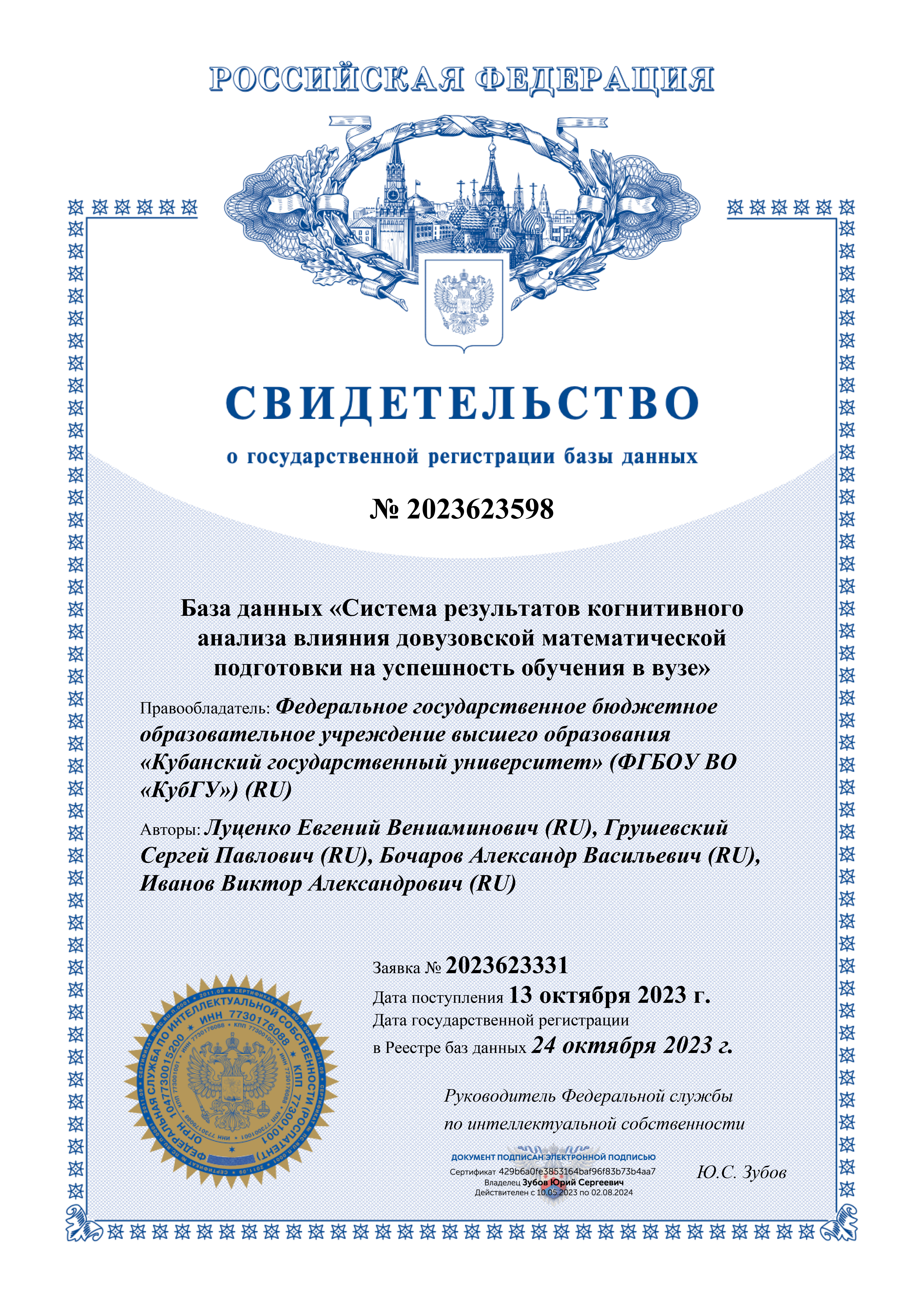
Свидетельство о государственной регистрации базы данных № 2023623598 Российская Федерация. База данных «Система результатов когнитивного анализа влияния довузовской математической подготовки на успешность обучения в вузе»: № 2023623331: заявл. 13.10.2023: опубл. 24.10.2023 / Е.В. Луценко, С.П. Грушевский, А.В. Бочаров, В.А. Иванов; заявитель ФГБОУ ВО «Кубанский государственный университет». EDN: OGDTGK. http://lc.kubagro.ru/aidos/2023623598.jpg
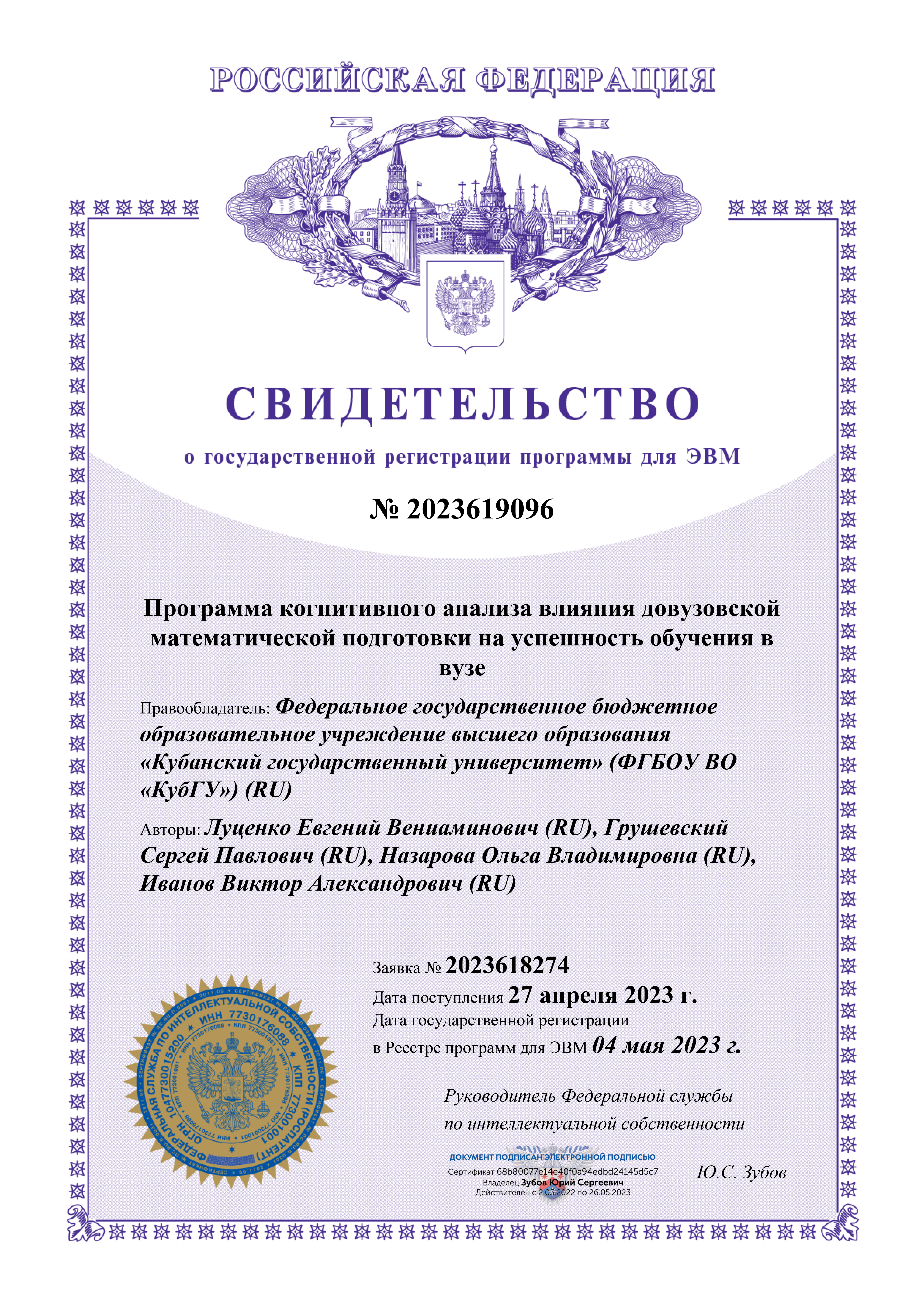
Свидетельство о государственной регистрации программы для ЭВМ № 2023619096 Российская Федерация. Программа когнитивного анализа влияния довузовской математической подготовки на успешность обучения в вузе: № 2023618274: заявл. 27.04.2023: опубл. 04.05.2023 / Е.В. Луценко, С.П. Грушевский, О.В. Назарова, В.А. Иванов; заявитель ФГБОУ ВО «Кубанский государственный университет». – EDN EOVGMS. http://lc.kubagro.ru/aidos/2023619096.jpg
Wake G. (2011). Introduction to the Special Issue: deepening engagement in mathematics in pre-university education. Research in Mathematics Education, 13(2), 109-118.
Castillo-Sánchez M., Gamboa-Araya R., & Hidalgo-Mora R. (2018). Concordance between introductory university mathematics courses and the program of pre-university studies: A view from the perspectives of content and academic performance. Uniciencia, 32(2), 20-41.
Hutcheson G.D., Pampaka M., & Williams J. (2011). Enrolment, achievement and retention on ‘traditional’and ‘Use of Mathematics’ pre-university courses. Research in Mathematics Education, 13(2), 147-168.
King N.C., & Hambrook G. (2021). Examining the impact of pre-university qualifications on success in interdisciplinary science. Journal of Further and Higher Education, 45(9), 1192-1205.
Johnson P., & O’Keeffe L. (2016). The effect of a pre-university mathematics bridging course on adult learners’ self-efficacy and retention rates in STEM subjects. Irish Educational Studies, 35(3), 233-248.
McAlinden M., & Noyes A. (2019). Mathematics in the disciplines at the transition to university. Teaching Mathematics and Its Applications: International Journal of the IMA, 38(2), 61-73.
Loong T.E. (2012). Predicting pre-university international students’ math performance by learning strategies and math anxiety in Malaysia. Journal of Educational and Social Research, 2(2), 73-83.
Nicholas J., Poladian L., Mack J., & Wilson R. (2015). Mathematics preparation for university: entry, pathways and impact on performance in first year science and mathematics subjects. International Journal of Innovation in Science and Mathematics Education, 23(1).
Seng E.L.K. (2015). The Influence of Pre-University Students' Mathematics Test Anxiety and Numerical Anxiety on Mathematics Achievement. International Education Studies, 8(11), 162-168.
García-García J., & Dolores-Flores C. (2021). Exploring pre-university students’ mathematical connections when solving Calculus application problems. International Journal of Mathematical Education in Science and Technology, 52(6), 912-936.
Van Herpen S.G., Meeuwisse M., Hofman W.A., Severiens S.E., & Arends L.R. (2017). Early predictors of first-year academic success at university: pre-university effort, pre-university self-efficacy, and pre-university reasons for attending university. Educational Research and Evaluation, 23(1-2), 52-72.
Loong T.E. (2012). Self-regulated learning strategies and their effects on math performance of pre-university international students in Malaysia. Journal of Education and Vocational Research, 3(3), 89-97.
Castillo Sánchez M., Gamboa Araya R.W., & Hidalgo Mora R. (2018). Concordance between introductory university mathematics courses and the program of pre-university studies.
Abd Wahid N., & Shahrill M. (2014). Pre-university students’ engagement towards the learning of mathematics. Proceeding of the Social Sciences Research ICSSR, 379-388.
Schoeffel P., Wazlawick R.S., & Ramos V. (2017, November). Impact of pre-university factors on the motivation and performance of undergraduate students in software engineering. In 2017 IEEE 30th Conference on Software Engineering Education and Training (CSEE&T) (pp. 266-275). IEEE.
Dolores-Flores C., Rivera-López M.I., & García-García, J. (2019). Exploring mathematical connections of pre-university students through tasks involving rates of change. International Journal of Mathematical Education in Science and Technology, 50(3), 369-389.
Beng Y.H., & Yunus A.S. B.M. (2015, August). What to measure in the level of mathematical thinking among preuniversity Science students? In 2015 International Conference on Research and Education in Mathematics (ICREM7) (pp. 165-168). IEEE.
Daza V., Makriyannis N., & Rovira Riera C. (2013). MOOC attack: Closing the gap between pre-university and university mathematics. Open Learning: The Journal of Open, Distance and e-Learning, 28(3), 227-238.
Tang E.L. (2015). Self-regulated learning of pre-university students in mathematics classrooms. Tang EL (2013). Self-regulated learning of pre-university students in mathematics classrooms. Journal of Educational Sciences and Psychology, 3(2), 40-47.
Wandel A.P., Robinson C., Abdulla S., Dalby T., Frederiks A., & Galligan L. (2015). Students’ mathematical preparation: differences in staff and student perceptions. International Journal of Innovation in Science and Mathematics Education, 23(1).
Loong T.E. (2012). Self-regulated learning strategies and pre-university math performance of international students in Malaysia. Journal of International Education Research, 8(3), 223.
Lyakhova S., & Neate A. (2021). Further Mathematics, student choice and transition to university: part 2 – non-mathematics STEM degrees. Teaching Mathematics and its Applications: An International Journal of the IMA, 40(3), 210-233.
Shallcross D.E., Allan N.L., Shallcross K.L., Croker S.J., Smith D.M., May P.W., ... & Price G.J. (2011). Solving the maths problem in chemistry: The impact of a pre-university maths summer school. New Directions in the Teaching of Natural Sciences, (7), 58-62.
Turşucu S., Spandaw J., Flipse S., Jongbloed G., & de Vries M.J. (2018). Teachers’ beliefs systems about improving transfer of algebraic skills from mathematics into physics in senior pre-university education. International Journal of Science Education, 40(12), 1493-1519.
Rylands L.J., & Coady C. (2009). Performance of students with weak mathematics in first-year mathematics and science. International journal of mathematical education in science and technology, 40(6), 741-753.
Suliman N.A., Abidin B., Manan N.A., & Razali A.M. (2014, September). Predicting students’ success at pre-university studies using linear and logistic regressions. In AIP Conference Proceedings (Vol. 1613, No. 1, pp. 306-316). American Institute of Physics.
Martín-Cudero D., Cid-Cid A.I., & Guede-Cid R. (2024). Analysis of Mathematics Education from a STEAM Approach at Secondary and Pre-Universitary Educational Levels: A Systematic Review. Journal of Technology and Science Education, 14(2), 507-528.
Луценко Е.В. Математическое моделирование и анализ данных в садоводстве: Учебник (изд. 2-е) / Е.В. Луценко. – Краснодар: Эйдос, 2023. – 573 с. EDN: XRQTOW, https://www.researchgate.net/publication/374029841
Downloads
Published
Issue
Section
License
Copyright (c) 2024 Historical and social-educational idea

This work is licensed under a Creative Commons Attribution-NonCommercial-NoDerivatives 4.0 International License.